
How to Choose French Country Interior Doors: A Buying Guide
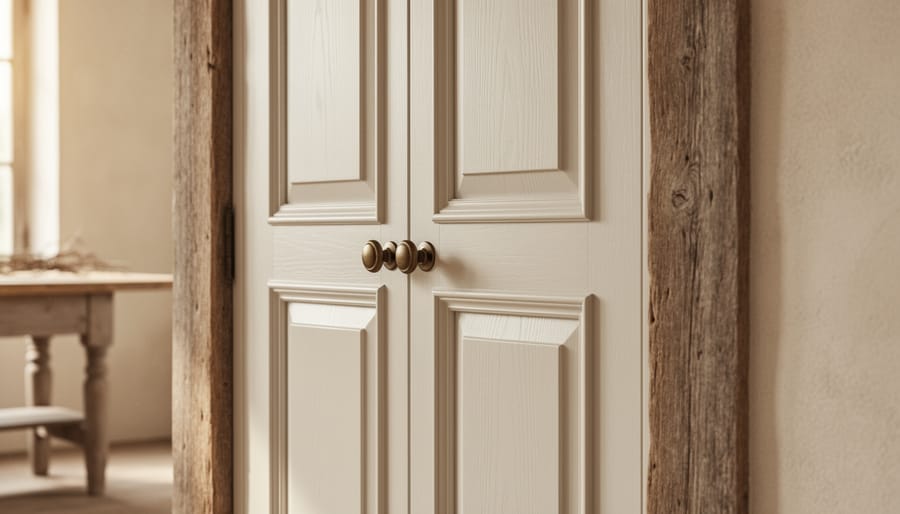
French country interior doors bring the warmth of Provence directly into your home through paneled wood construction, soft neutral finishes, and architectural details that balance rustic charm with elegant simplicity. Choosing the right doors means understanding three essential elements: authentic materials (solid wood or high-quality engineered alternatives), proportions that match traditional French design (typically six or eight panels with raised profiles), and finishes that complement the French country aesthetic without looking artificially distressed.
The doors you choose set the tone for entire rooms. Too modern, and they clash with vintage-inspired fixtures and farmhouse tables. Too ornate, and they overwhelm the relaxed, livable spirit that makes French country style so appealing to homeowners in 2026.
Working with certified interior designers and door specialists, we’ve identified what separates authentic French country doors from generic alternatives. The difference lies in panel depth, wood grain visibility, hardware placement, and finish techniques that create aged patina without looking forced. These details matter because French country design celebrates craftsmanship and natural materials, not shortcuts.
This guide walks you through door types suited to French country interiors, critical factors that affect both appearance and longevity, specific recommendations for 2026, and mistakes that compromise the look you’re working to achieve. Whether you’re renovating a single room or transforming your entire home, the right doors anchor your design vision.
What Makes French Country Interior Doors Unique
French country interior doors stand apart through their unmistakable blend of refined craftsmanship and lived-in warmth. Unlike minimalist modern doors or heavily ornate Victorian styles, these doors strike a balance between elegance and approachability, they feel sophisticated without being formal, detailed without being fussy. This distinctive character comes from centuries-old design traditions rooted in rural French provinces, where practicality met artisanal pride.
The most recognizable feature is the paneled construction. Traditional French country doors typically showcase raised or recessed panels, often four or six panels arranged symmetrically, that create depth and visual interest. These panels aren’t merely decorative; they reflect historical construction methods that accommodated wood expansion and contraction while maintaining structural integrity. The proportions tend toward generous dimensions with substantial stiles and rails, giving the doors a reassuring presence that anchors a room.
Material authenticity defines the style. Genuine French country doors favor solid wood species like oak, pine, or walnut, prized for their natural grain patterns and ability to develop a rich patina over time. Even when budget considerations lead toward engineered alternatives, the goal remains capturing that organic, textured quality that synthetic materials struggle to replicate.
Several signature elements immediately signal French country style:
- Raised or recessed panels with traditional symmetrical arrangements
- Distressed or hand-rubbed finishes that suggest age and character
- Natural wood tones, from honey-colored pine to weathered gray oak
- Glass inserts with divided lights or seeded glass for soft transparency
- Arched tops that add graceful curves to rectangular architecture
- Wrought iron or aged bronze hardware with visible craftsmanship
Beyond their individual beauty, French country doors create architectural continuity throughout your home. When you select doors that share these characteristics across multiple rooms, they establish a cohesive aesthetic thread that ties spaces together. They soften transitions between areas while maintaining distinct room identities, a hallway feels less like a passage and more like an intentional design element when flanked by thoughtfully chosen doors.
Key Factors to Consider When Buying French Country Interior Doors
Material and Construction Quality
Material choice dramatically affects both the authenticity and longevity of your French country interior doors. Solid wood remains the gold standard, delivering the heft, grain patterns, and aging characteristics that define genuine French country style. Oak, pine, and walnut are traditional favorites. These doors develop a rich patina over time and can be refinished multiple times, making them a true long-term investment. Expect them to weigh 60-80 pounds for a standard interior door, which means you’ll need sturdy hinges and properly installed frames.
Engineered wood offers a middle ground. These doors feature a solid wood frame with a wood veneer surface over an engineered core. They resist warping better than solid wood, cost about 30-40% less, and still provide genuine wood grain that accepts stains beautifully. The trade-off? You can’t refinish them as many times, and they lack the substantial feel of full solid construction.
MDF (medium-density fiberboard) doors sit at the budget end. Modern MDF doors can mimic paneled designs convincingly from a distance, and their smooth surface takes paint well. However, they’re noticeably lighter, less durable around hinges and latches, and vulnerable to moisture damage. For French country style, where authenticity matters, MDF works best for closets or secondary spaces rather than main living areas.
| Material Type | Authenticity Level | Durability | Price Range | Best For |
|---|---|---|---|---|
| Solid Wood | Highest | Excellent (refinishable) | $400-$1,200+ | Main rooms, authentic aesthetics |
| Engineered Wood | Good | Very Good (warp-resistant) | $250-$700 | Most interior applications |
| MDF | Lower | Moderate (moisture-sensitive) | $150-$400 | Closets, budget projects |
When evaluating construction quality, examine the joinery. Quality French country doors use mortise-and-tenon joints or dovetails in their frame construction, not just glue and staples. Check that panels float freely in their frames rather than being rigidly fixed, this allows for wood movement without cracking. Run your hand over the surface to feel for consistent thickness in the stiles and rails, and inspect corners for tight, even gaps.
Door Style and Panel Configuration
The panel configuration of your French country door dramatically influences its visual impact and authenticity. Classic raised panel doors remain the most traditional choice, featuring three to five dimensional panels that create shadows and depth, this style works beautifully in formal spaces like dining rooms and primary bedrooms where you want to emphasize elegance.
Flat panel doors offer a cleaner, more understated interpretation of French country style. Their simpler profile suits kitchens, laundry rooms, and casual living spaces where you don’t want the door competing with other design elements. These work particularly well in smaller homes where too much ornamentation can feel overwhelming.
Arched top panels add romantic charm and architectural interest, making them ideal for entries to libraries, studies, or any room where you want to create a memorable transition. The gentle curve softens the overall look while maintaining traditional proportions.
Glass panel inserts deserve special consideration based on room function. Use them in spaces where you want to borrow light or maintain visual connection, between kitchens and dining areas, or separating home offices from hallways. For bedrooms and bathrooms, stick with solid panels for privacy.
Match your door style to your home’s existing trim work and ceiling height. Grander homes with elaborate moldings can handle more ornate panel configurations, while cottages look best with simpler two or three-panel designs.
Finish and Color Options
Finish selection shapes your French country doors’ entire character. Natural wood stains in warm honey, medium walnut, or rich oak tones showcase grain patterns and create that authentic Old World feel most buyers want. These work beautifully in homes with exposed beams or other natural wood elements.
Distressed painted finishes deliver instant charm. Soft whites, creamy ivories, and muted grays with intentional wear at edges and raised panels mimic decades of use. This approach pairs perfectly with farmhouse-style spaces and lighter color schemes. Whitewashed finishes offer a middle ground, preserving visible wood grain beneath translucent white or pale gray creates depth without heaviness.
Antique glazes applied over painted doors add dimension through darker tones settling into recesses and panel details. This technique enhances architectural features and coordinates well with similar treatments on cabinetry.
Match your door finish to existing trim first, then consider wall colors. Contrasting doors create focal points, while matching trim maintains cohesion. In rooms requiring regular maintenance like kitchens, choose finishes compatible with your deep cleaning tips and household routines. Test samples in your actual lighting before committing, natural and artificial light dramatically affect how finishes appear throughout the day.
Size and Proportion Guidelines
Standard French country interior doors typically measure 80 inches tall and range from 24 to 36 inches wide. The 30-inch width works well for bedrooms and bathrooms, while 32 to 36 inches suits primary spaces like master suites or main living areas where grander proportions reinforce the style’s elegance.
Ceiling height matters considerably. In homes with 8-foot ceilings, standard 80-inch doors maintain proper scale. But if you have 9 or 10-foot ceilings, consider upgrading to 84 or 96-inch doors to prevent the awkward visual gap that makes standard doors look shrunken. French country design values balanced proportions, so taller openings deserve taller doors.
Custom sizing makes sense in older homes with non-standard openings or when you’re aiming for architectural continuity throughout your space. Yes, custom doors cost 40 to 60 percent more than stock options, but they eliminate the need for extensive frame modifications and deliver seamless results.
Measure your rough opening carefully before ordering. Account for jamb thickness and necessary clearances. When in doubt about proportions, wider generally reads more authentically French country than narrow, especially for primary rooms where you want that welcoming, substantial presence.
Hardware and Accessories
Hardware often separates an authentic French country door from one that falls flat. The right handles, hinges, and accessories don’t just function, they reinforce the rustic elegance and Old World craftsmanship at the heart of French country style.
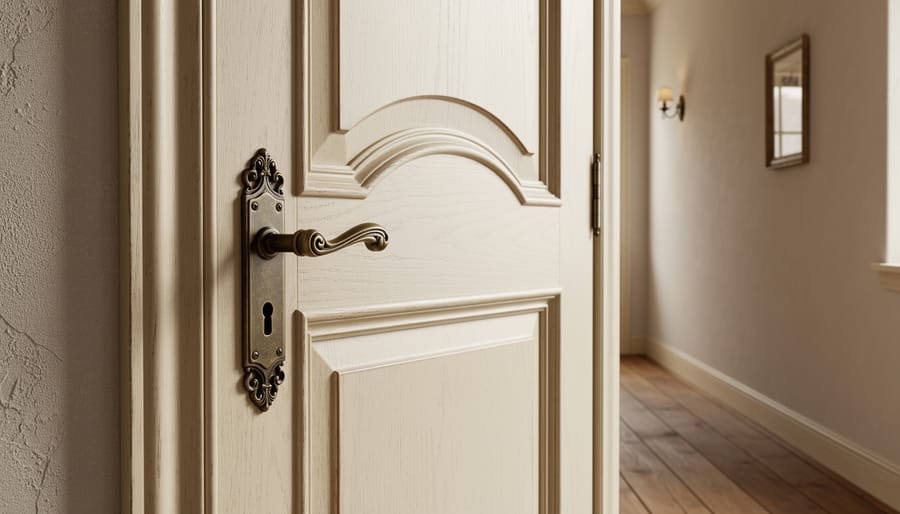
Wrought iron remains the gold standard for French country door hardware. Look for pieces with subtle imperfections and hand-forged character rather than perfectly uniform finishes. Thumb latches, lever handles with decorative scrollwork, and ornate pull handles all work beautifully. Antique bronze and oil-rubbed bronze finishes offer slightly softer alternatives that still read as authentic, especially when they show natural variations in tone.
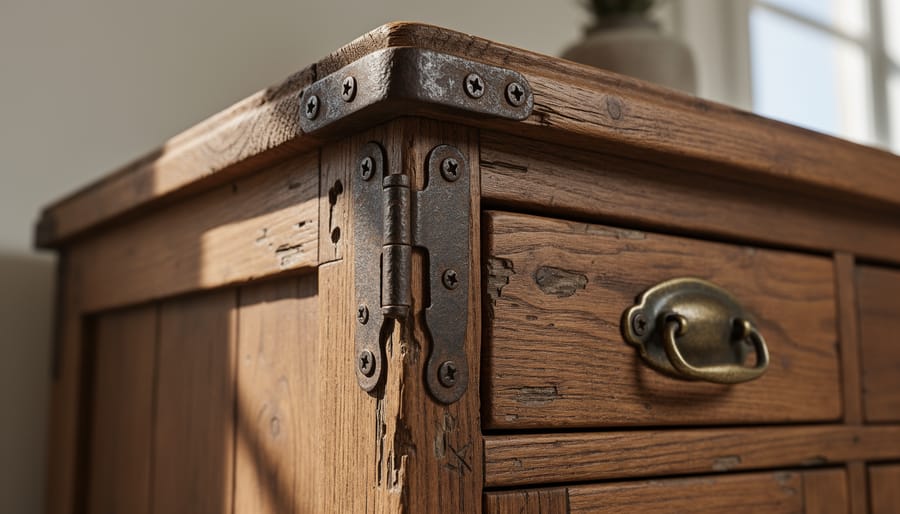
Hinges deserve equal attention. Decorative strap hinges that extend across the door face add dramatic visual interest, particularly on entryways between major rooms. Standard butt hinges should match your handle finish and feel substantial to the touch.
Decorative back plates, rosettes, and escutcheons around handles and keyholes provide finishing touches that elevate the entire presentation. Choose designs with gentle curves, floral motifs, or traditional French provincial patterns. Avoid overly ornate baroque styles that veer into formal territory rather than country charm.
Consider matching hardware across doors in connected spaces for visual continuity, but don’t stress about uniformity throughout the entire home. Varying pieces slightly by room can actually enhance the collected-over-time aesthetic that defines authentic French country interiors.
Types of French Country Interior Doors Compared
Traditional Solid Wood Panel Doors
Traditional solid wood panel doors represent the gold standard for French country interiors, offering authenticity that’s hard to replicate. These doors are typically crafted from oak, pine, or poplar, woods that age beautifully and develop character over time.
The primary advantage? Genuine solid wood brings weight, substance, and a tactile quality that immediately signals quality. You can refinish them multiple times, distress them for a lived-in look, or leave them natural to showcase the grain. They’re also remarkably durable; a well-made solid wood door can last decades.
The drawbacks center on cost and maintenance. Expect to pay $400, $1,200 per door depending on wood species and craftsmanship. Solid wood expands and contracts with humidity changes, which can cause sticking or gaps if not properly sealed. It’s also heavier, requiring sturdy hinges and proper installation.
Look for mortise-and-tenon joinery rather than butt joints, which indicates superior construction. Check that panels float within the frame, they shouldn’t be glued solid, allowing for natural wood movement. Doors with through-dowel construction or wooden pegs signal traditional craftsmanship that aligns perfectly with French country aesthetics.
Best applications include primary living spaces like dining rooms, studies, and master bedrooms where the investment makes the strongest visual impact.
French Doors with Glass Inserts
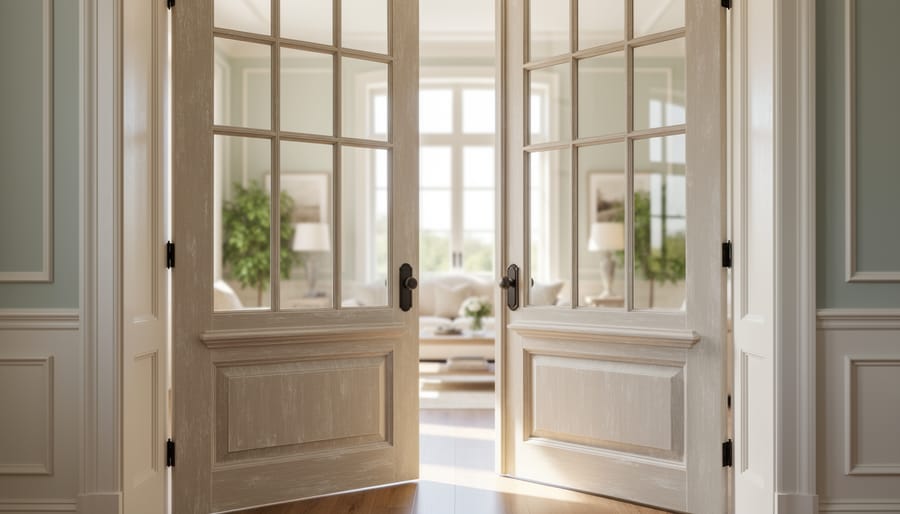
French doors with glass inserts bring a signature elegance to interior spaces while solving practical challenges common in French country homes. These doors maintain visual flow between rooms without sacrificing definition, allowing natural light to travel deeper into your home, a key consideration in authentic French country design where bright, airy spaces are paramount.
The glass component transforms these doors into something beyond mere room dividers. They create what designers call “borrowed light,” particularly valuable in hallways, home offices, or interior rooms that lack exterior windows. A dining room separated from a kitchen with glass-panel French doors, for example, feels connected to the heart of the home while maintaining its formal character.
Glass options range from clear to various obscured treatments. Clear glass maximizes light transmission and visual connection, working beautifully between public spaces like living rooms and dining areas. Seeded or wavy glass adds period-appropriate character and subtle privacy, ideal for fresh French country interpretations. Frosted or reeded glass provides more privacy for spaces like home offices or powder rooms while still allowing light flow.
Consider French doors with glass inserts when you need to maintain sightlines, enhance natural light distribution, or create an elegant threshold between formal and casual spaces. They’re particularly effective in open floor plans where you want flexible separation without building solid walls.
Engineered and Composite Options
Engineered and composite doors offer a practical entry point for homeowners working within tighter budgets or concerned about wood’s response to humidity fluctuations. These doors feature a wood veneer or MDF surface with raised panel profiles that mimic traditional solid wood construction, often at 40-60% of the cost.
Modern manufacturing has improved significantly. Mid-range engineered doors now deliver convincing visual appeal from typical viewing distances, with clean panel lines and smooth finishes. The veneer thickness matters, look for at least 1/8 inch for durability during cleaning and minor impacts.
However, set realistic expectations. Composite doors lack the tactile warmth and slight irregularities that give solid wood its character. Close inspection reveals more uniform grain patterns and a lighter feel. They’re also less forgiving if damaged, gouges can’t be sanded and refinished like real wood.
Where they excel: consistent dimensions that simplify installation, resistance to warping in bathrooms or laundry rooms, and paint-grade surfaces that accept distressed finishes well. For secondary bedrooms, closets, or rentals where budget constraints are significant, quality engineered doors provide acceptable French country style without the premium investment. Just avoid the cheapest options, their hollow cores and paper-thin veneers betray the aesthetic immediately.
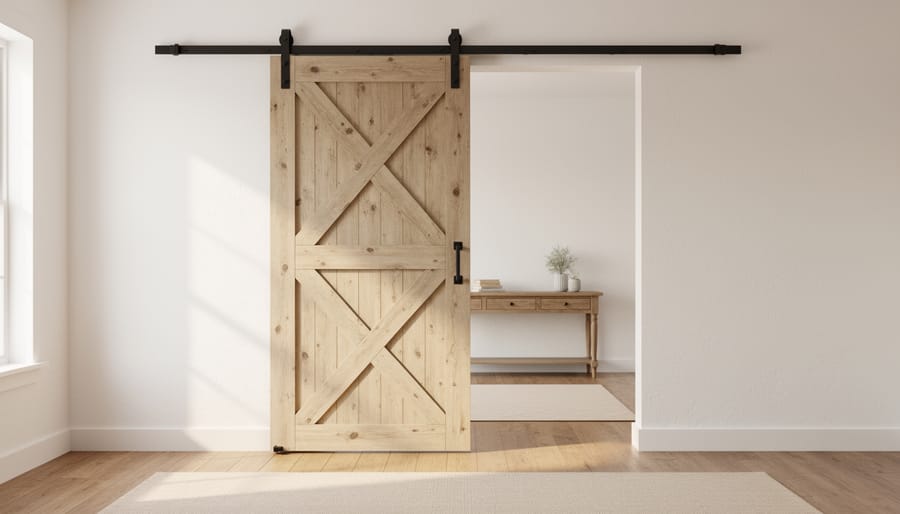
Barn-Style Sliding Doors with French Country Details
Sliding barn doors offer a practical solution for French country homes where traditional swing doors won’t work, particularly in tight hallways, closets, or spaces where you need to preserve floor clearance. The key is selecting doors with authentic French country panel configurations rather than generic flat slabs.
Look for barn doors featuring raised or recessed panels that mimic traditional French door construction. Five-panel vertical configurations work beautifully, as do arched-top designs that echo classic French architecture. A whitewashed or distressed painted finish maintains the rustic elegance essential to the style.
Hardware makes or breaks the French country look with barn doors. Skip industrial black metal in favor of oil-rubbed bronze, antique brass, or wrought iron track systems. Choose decorative pulls and handles with traditional scroll work rather than modern minimalist designs.
These doors work exceptionally well for pantries, laundry rooms, and bedroom closets where space constraints make traditional doors impractical. Just remember that barn doors don’t provide sound isolation, so they’re less suitable for bathrooms or home offices requiring privacy. When properly styled, they blend French country charm with modern functionality.
Our Top Recommendations for French Country Interior Doors in 2026
After consulting with certified interior designers who specialize in French country aesthetics, we’ve identified standout door options across multiple categories. These recommendations balance authentic style with practical considerations like budget, customization needs, and room-specific requirements.
| Product Category | Key Features | Price Range | Best For | Why We Recommend It |
|---|---|---|---|---|
| Best Overall: Solid Oak Raised Panel Door | Six-panel construction, natural grain, pre-hung option available | $400-$700 | Main living areas, master bedrooms | Authentic weight and texture that ages beautifully; solid wood construction ensures longevity |
| Best Budget-Friendly: Engineered Panel Door with Wood Veneer | Four-panel design, paintable surface, standard sizes | $150-$300 | Guest rooms, closets, secondary spaces | Captures French country proportions at half the cost without looking obviously synthetic |
| Best Custom: Handcrafted Arched Panel Door | Custom sizing, hand-planed details, choice of hardwoods | $1,200-$2,500 | Entryways, formal dining rooms, statement spaces | Allows perfect integration with existing architecture and unique proportions; heirloom quality |
| Best for Kitchens: French Door with Seeded Glass | Eight-lite configuration, distressed finish options, 36″ standard width | $500-$900 | Pantries, kitchen-dining transitions | Provides light transmission while maintaining privacy; seeded glass adds rustic character |
The solid oak raised panel door earns our top overall recommendation because it delivers true French country character. The natural grain variation and substantial feel immediately signal quality. We’ve seen these doors develop a rich patina over time that engineered alternatives can’t match.
For homeowners working within tighter budgets, the engineered panel door with wood veneer offers surprising authenticity. The key is choosing options with realistic panel depth and proper proportions. When painted in traditional French country colors and paired with quality hardware, these doors look far more expensive than their price tag suggests.
If you’re renovating a historic home or want a truly custom fit, the investment in handcrafted arched panel doors pays dividends. Our design partners consistently report that clients who splurge on custom doors for focal areas never regret the expense. These doors become conversation pieces that anchor the entire French country aesthetic.
For kitchen applications specifically, we recommend French doors with seeded glass inserts. They solve the practical need for visual connection between spaces while the textured glass maintains an appropriate level of privacy and adds rustic charm that complements farmhouse sinks and open shelving.
Common Mistakes to Avoid When Choosing French Country Doors
The enthusiasm for French country style sometimes leads homeowners to make purchasing decisions they later regret. One of the most frequent mistakes is selecting doors that lean too contemporary or minimalist, which clashes with the traditional warmth French country requires. While modern French country can blend old and new successfully, the doors themselves need enough traditional detail to anchor the look.
Here are the most common pitfalls to watch for:
- Choosing doors with flat, featureless surfaces that lack the panel definition French country demands
- Mismatching hardware styles by mixing brushed nickel with oil-rubbed bronze or combining sleek modern pulls with traditional doors
- Ignoring proportion by installing oversized doors in modest rooms or standard-height doors where taller options would better suit the architecture
- Skimping on finish quality with cheap stains that look orange or painted finishes without proper distressing technique
- Overlooking installation requirements for solid wood doors, which need professional hanging and proper clearance for seasonal expansion
- Mixing inconsistent door styles throughout the home, creating a disjointed appearance rather than a cohesive aesthetic
Another significant error is prioritizing price over authenticity to the point where the doors undermine your entire French country vision. An engineered door can work beautifully if it has proper panel detailing and quality finishing, but a flat slab door painted cream will never achieve the look, regardless of how you style the surrounding space. Similarly, many homeowners select doors first and hardware as an afterthought, then find that standard modern hinges and handles ruin the effect they worked to create.
The final mistake worth mentioning is failing to consider how doors will look when open. French country spaces flow naturally from room to room, and your doors will spend much of their time standing open against walls. If the back side receives a cheap finish or mismatched color, that corner of every room will broadcast the shortcut you took.
Frequently Asked Questions
Can I install French country doors in a modern home?
Absolutely. French country doors can create beautiful contrast in contemporary spaces, especially when you choose cleaner panel configurations and lighter finishes. The key is selecting doors with simpler lines rather than heavily ornate styles, which helps them complement modern architecture while adding warmth and character.
What’s the typical cost range for French country interior doors?
Expect to pay anywhere from $150 to $800 per door depending on material, construction quality, and customization. Basic MDF or composite options start around $150 to $300, mid-range engineered wood doors run $300 to $500, while solid wood doors typically range from $500 to $800 or more for premium or custom designs.
Should all my interior doors match exactly?
Not necessarily. While doors on the same floor should coordinate in style and finish, you can vary the configuration based on room function. For example, bedroom doors might be solid panels while your office could feature glass inserts for more light flow, as long as they share the same wood tone and panel design language.
How do I maintain wood French country doors?
Regular dusting and an occasional wipe-down with a slightly damp cloth keeps most wood doors looking fresh. Include your doors in your regular cleaning routine and every few months, apply a quality wood polish or conditioner to nourish the finish and prevent drying or cracking.
Can I install these doors myself or should I hire a professional?
If you have basic carpentry skills and the right tools, installing a pre-hung door is a manageable DIY project. However, if you’re dealing with custom sizes, need to adjust the frame, or want perfect alignment and professional-grade results, hiring an experienced installer is worth the investment.
What’s the difference between French country and farmhouse doors?
While both styles embrace rustic charm, French country doors typically feature more refined paneling, curved or arched details, and elegant proportions that reflect European influences. Farmhouse doors tend toward simpler, more utilitarian designs with straighter lines and a more casual, American country aesthetic.
These questions represent the concerns we hear most often from homeowners embarking on French country renovations. The beauty of French country doors lies in their versatility and timeless appeal, which means they can adapt to various homes, budgets, and skill levels. Whether you’re doing a complete home transformation or updating a single room, understanding these practical considerations helps you make decisions with confidence and avoid second-guessing your choices down the road.
Choosing French country interior doors comes down to balancing authenticity with practicality. Focus on the elements that matter most: quality materials that age gracefully, panel configurations that reflect traditional proportions, and finishes that bring warmth rather than sterile perfection. Whether you invest in solid wood doors or opt for well-crafted engineered alternatives, prioritize pieces that feel substantial and showcase genuine craftsmanship.
Your doors are more than functional barriers. They’re architectural statements that tie your rooms together, anchor your design choices, and invite people to move through your home with a sense of comfort and history. When you walk past a properly chosen French country door, you should feel like it belongs, not like it’s trying too hard or cutting corners to mimic the style.
Start with one room if budget constraints are real. Replace the most visible interior door first, match your hardware thoughtfully, and let that set the tone for future updates. The French country aesthetic builds over time, layer by layer, and your doors provide the framework that makes everything else fall into place. You’ve got the knowledge now, make your selection with confidence.